Digital Rate Board vs LED Display Board: Real Costs Compared
LED currency boards cost hundreds to thousands of dollars plus installation. A software rate board runs on the TV you already have. Here's the honest comparison.
· 7 min read
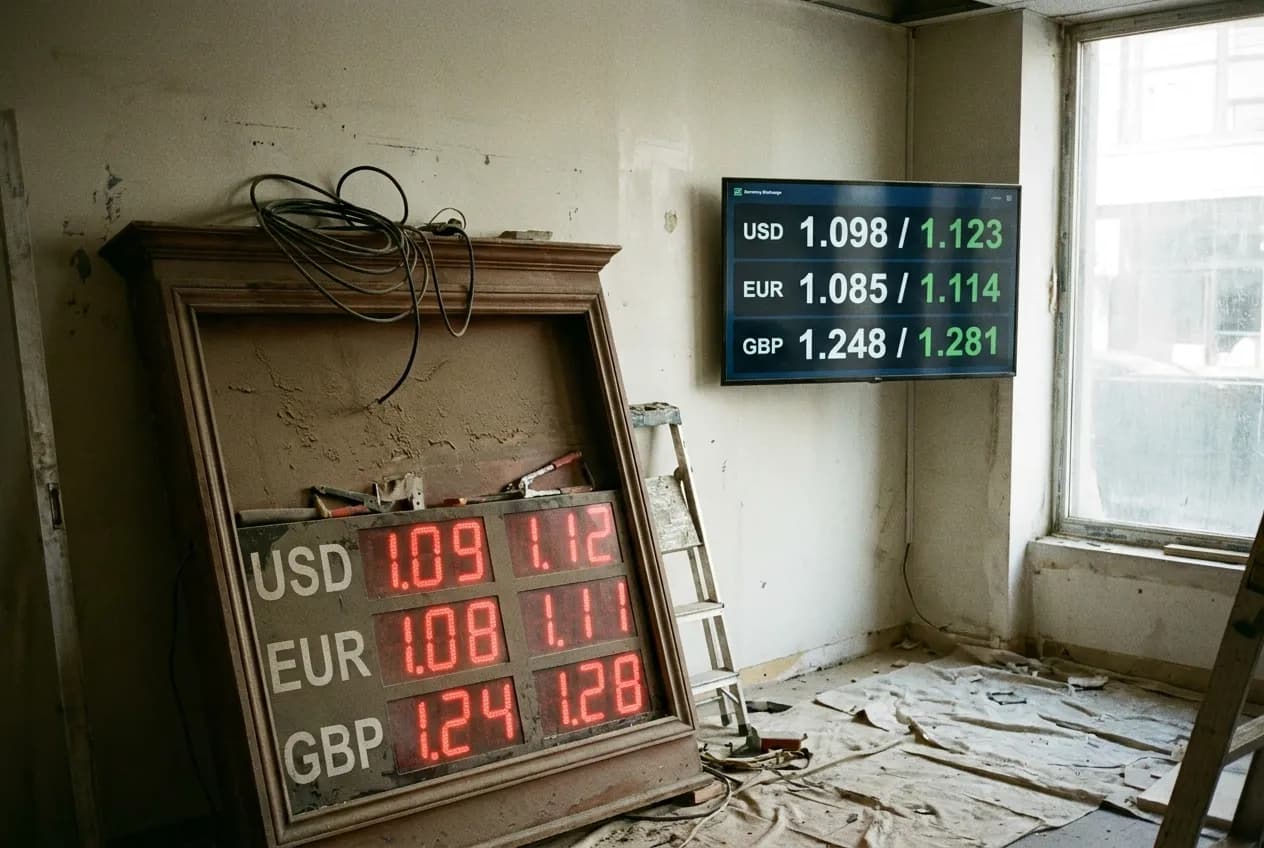
Search for an LED currency display board and the quotes add up fast: a purpose-built panel typically runs from several hundred to a few thousand dollars, before mounting and installation. For a small exchange shop, that can be one of the biggest single equipment purchases you make.
Before you order one, it’s worth knowing there’s a second way to get a bright, professional rate display behind your counter: a software rate board running on a TV you already own. Sometimes the LED panel is still the right call — and this comparison will tell you exactly when. But if you run an indoor counter, the honest answer is that software usually does the same job for a fraction of the cost.
Here’s how the two options compare on cost, installation, and day-to-day use.
What an LED Rate Board Is and What It Costs
An LED rate board is dedicated hardware: a panel with a grid of currency rows — usually a printed flag and currency code next to bright seven-segment or dot-matrix digits — showing your buy and sell prices. You program the numbers with a remote control, a small keypad, a USB stick, or the manufacturer’s software, depending on the model.
Because it’s purpose-built signage, the important specs are locked in when you order: how many currency rows, single- or double-sided, indoor or high-brightness outdoor, and the physical size of the panel. Those choices are also what drive the price.
- Small indoor panels with a handful of currency rows typically start at several hundred dollars.
- Larger multi-row boards, double-sided units, and high-brightness or outdoor-rated models commonly reach into the thousands.
- On top of the panel itself, budget for shipping (these are heavy), wall mounting, a power run to the mounting spot, and often an installer or electrician.
None of that is a rip-off — you’re paying for bright, always-on, purpose-built hardware. The question is whether your shop actually needs what that money buys.
What a Software Rate Board Is
A software rate board skips the dedicated hardware entirely. Your rates live on a webpage, and the “board” is any screen that can show that page — most commonly a smart TV’s built-in browser, or any TV with a cheap streaming stick or mini PC plugged into an HDMI port.
With Exchange Rate Management, it works like this: you set your own buy and sell rates in one dashboard, paste a one-line script onto any page of your website, open that page in the TV’s browser, and go fullscreen. When you change a rate in the dashboard, every screen showing that page updates in seconds — no ladder, no remote control, no walking over to the board.
The cost profile is the reverse of the LED panel: hardware is $0 if you already own a TV, and the software runs from free to US$9.99 per month. The free plan covers USD and EUR pairs, free forever; Pro is US$9.99/month (or US$99.99/year) and unlocks all 153 currencies. Realistically, you can go from signup to rates on a screen in about 10–15 minutes.
If you want the full picture of how this approach works, the digital rate board page covers it in detail, and we’ve written a step-by-step guide to displaying exchange rates on a TV screen.
Head-to-Head: LED Board vs Software Rate Board
Here’s the direct comparison, line by line. The software column assumes a TV you already own; if you’d need to buy a budget TV too, add that to the upfront row — the total is still usually well below a comparable LED panel.
| Factor | LED display board | Software rate board |
|---|---|---|
| Upfront cost | Several hundred to a few thousand dollars for the panel, plus mounting and installation | $0 with a TV you already own (or the price of a budget streaming stick if the TV has no browser) |
| Monthly cost | Usually none once installed, beyond electricity | Free for USD and EUR pairs; US$9.99/month for all 153 currencies |
| Installation | Wall mounting, a power run, often an installer or electrician | Open a webpage in the TV’s browser and go fullscreen — about 10–15 minutes |
| Changing rates | Keyed in per board with a remote, keypad, or vendor tool | Edited once in a dashboard; every screen updates in seconds |
| Changing layout or currencies | Rows and labels are fixed at purchase; adding currencies can mean new hardware | Add, remove, or reorder currencies from the dashboard at any time |
| Multiple branches | One panel bought, mounted, and updated separately per location | Every branch’s screen opens the same page; one edit reaches them all |
| Daylight and outdoor visibility | Excellent — high-brightness LEDs are built to be read in direct sunlight | Limited by the TV; standard consumer panels wash out in direct sun |
| Failure modes | Dead segments or a failed module mean repairing or replacing specialist hardware | A TV, browser, or connection hiccup — reopen the page or swap in any spare TV |
The rows that surprise people are the last four. Hardware wins on brightness, and it always will. Software wins on everything that changes — rates, currencies, layout, and the number of screens — because changing software is an edit, while changing hardware is a purchase.
Want to see the software side before you spend anything on hardware? A currency rate board runs in any TV browser, and USD and EUR pairs are free forever. See how the currency rate board works
When an LED Board Genuinely Wins
There are real situations where dedicated LED hardware is worth the money, and it’s better to know them before you commit either way.
- Outdoor-facing displays. If the board hangs outside or points at the street, it lives in weather and full daylight. Outdoor-rated LED panels are built for exactly that; consumer TVs are not.
- Direct-sunlight storefronts. High-brightness LEDs stay readable in direct sun. A standard TV in a sun-facing shop window washes out at exactly the hours you most want passersby to see your rates.
- Always-on signage without a browser device. An LED board is its own computer. There’s no browser to reopen and no stick to reboot — once the rates are keyed in, they stay lit until you change them, with no internet connection needed at the screen.
If one of those describes your shopfront, buy the LED board without guilt. Just budget for installation from the start, and remember that changing the layout later usually means changing the hardware.
When a Software Rate Board Wins
- Indoor counters. Behind the counter or on an inside wall, a modern TV is plenty bright — and that’s where most exchange businesses actually display rates.
- Multiple screens and branches. Every screen simply opens the same page. Two TVs or five branches, one dashboard edit updates all of them in seconds, instead of someone updating each panel on-site.
- Tight budgets. There’s no upfront hardware spend to recover. Start on the free plan with USD and EUR, prove it works on your TV, and only pay US$9.99/month if you need more currencies.
- Layout and currency freedom. LED rows are fixed at purchase. On a software board, adding a currency, dropping one for the season, or reordering the list is a dashboard change, not a hardware order.
- Remote updates. Rates move while you’re away from the shop. Edit them from any laptop or phone and every screen follows in seconds.
- One source of truth. The same one-line script that powers the TV board also shows your rates on your website, so the number on the screen and the number online never disagree.
The Bottom Line
If your rates need to be readable from the street, in direct sun, or on a display with no browser device attached, an LED display board is the right tool. Treat the panel, mounting, and installation as one project costing several hundred to a few thousand dollars, and it will serve you for years.
For everyone else — which in practice means most indoor exchange counters — a software rate board on the TV you already own does the same job with no upfront cost, more layout freedom, and rate changes that reach every screen in seconds.
The cheap way to decide: take 15 minutes, sign up for the free plan, put USD and EUR on your shop TV, and look at the screen from where your customers stand. If it’s bright and readable, you just saved the price of a panel. If it isn’t, buy the LED board knowing exactly why — you’ve spent nothing to find out.